Susanna Reid: The Journey of Britain’s Definitive Morning Broadcaster
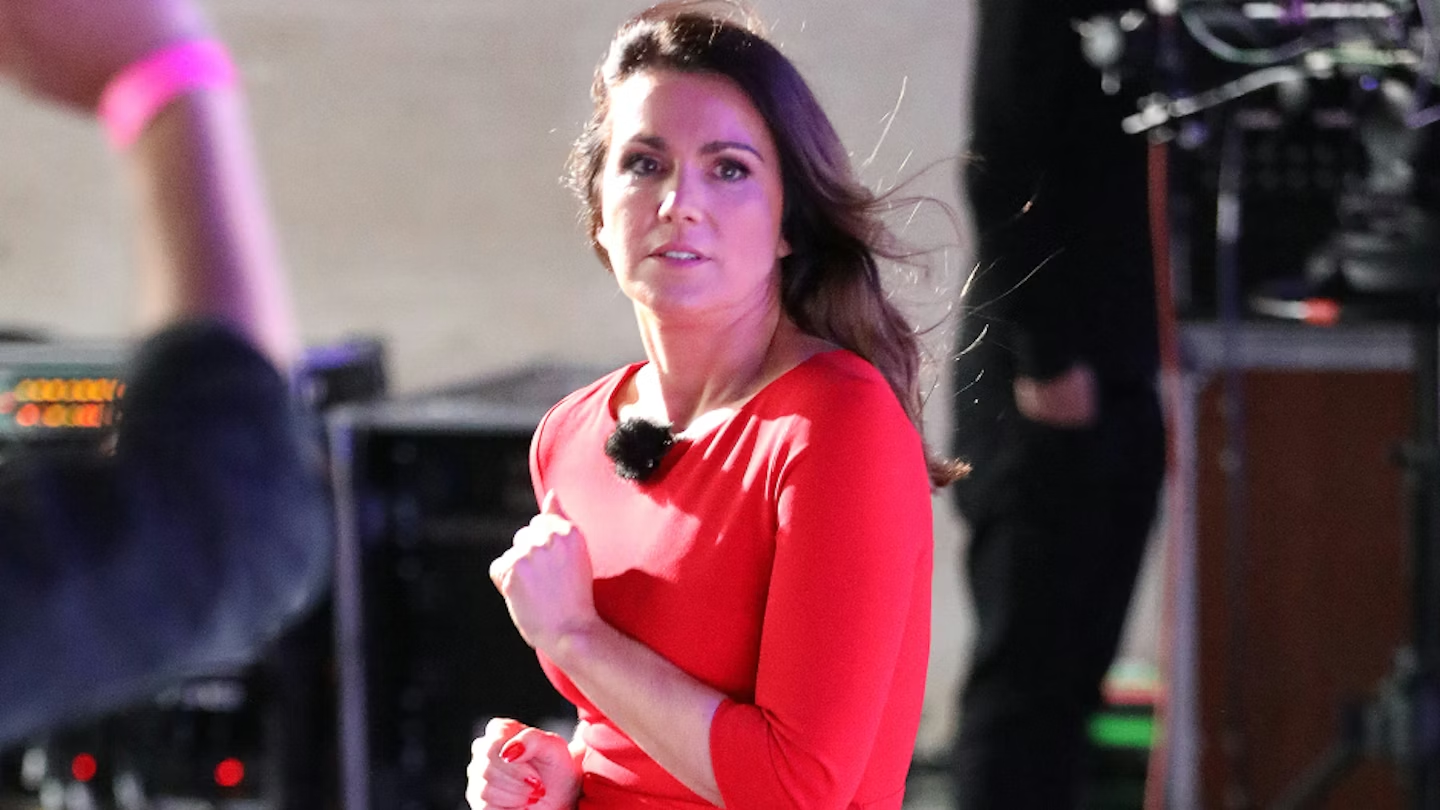
For over two decades, the face and voice of Susanna Reid have been a trusted fixture in millions of British homes. From the serious gravitas of BBC Breakfast to the combative, headline-making arena of ITV’s Good Morning Britain, her career arc is a masterclass in broadcast evolution, resilience, and sustained relevance. She is far more than a presenter; she is a cultural barometer, a formidable interviewer, and a professional who has navigated the seismic shifts in morning television with poise and principle. This comprehensive exploration delves beyond the headlines, unpacking the formative experiences, professional philosophy, and personal strength that define one of the UK’s most recognized and respected broadcasters. Understanding the story of Susanna Reid is to understand a significant chapter in modern British media itself.
Early Life and Formative Influences
The professional composure witnessed daily on screen was forged in a childhood that valued diligence and communication. Born in Croydon in 1970, Susanna Reid was raised in a close-knit family where her father’s career as a sales manager and her mother’s work as a department store supervisor instilled a strong work ethic. Education was a priority, and she excelled at Croham Hurst School before studying politics, philosophy, and economics at the University of Bristol, a classic academic path that sharpened her analytical mind. This foundation provided the critical thinking skills essential for dissecting complex news stories, long before she ever sat in a studio hot seat.
Her entry into media was not a sudden leap to stardom but a meticulous apprenticeship. After university, she pursued a postgraduate diploma in journalism at Cardiff University, a renowned training ground for news professionals. Her first roles were in local radio and regional television, grinding through the essential, unglamorous work of reporting. These early years covering court cases, local council meetings, and community events in Plymouth and Southampton were invaluable, teaching her to find the human angle in every story and connect with audiences beyond the metropolitan bubble—a skill that remains a hallmark of her presenting style to this day.
The BBC Breakfast Foundation
Susanna Reid’s national profile was cemented during her influential tenure at BBC Breakfast, where she spent over a decade. Joining the iconic red sofa in 2003, initially as a stand-in, she quickly became a permanent and beloved co-host alongside Bill Turnbull. This era defined her for a generation as a warm, authoritative, and empathetic presence during morning routines. The BBC’s public service remit allowed her to hone a balanced interviewing technique, handling everything from light-hearted entertainment features to profound human-interest stories and breaking political news with equal adeptness. It was here that she built an immense reservoir of public trust.
Her departure from the BBC in 2014 was a major industry moment, highlighting her ambition and the competitive shift in morning television. The move to ITV and the nascent Good Morning Britain was a calculated risk, leaving the comfort of a well-established ratings leader for a challenging, revamped format. This transition signified a desire to engage in more robust, agenda-setting journalism and to be part of a program with a distinctively different, more interrogative tone. It demonstrated that Susanna Reid was not content with a static role but was actively shaping her career trajectory toward a new kind of broadcast influence.
Defining Good Morning Britain and a New Era
The launch and evolution of Good Morning Britain with Susanna Reid as a central anchor fundamentally altered the UK’s morning TV landscape. The program was conceived as a direct, punchier alternative to its rivals, embracing debate, controversy, and holding power to account. Reid, alongside co-hosts like Piers Morgan and later Ben Shephard, Kate Garraway, and others, had to adapt her style to this dynamic. She became the crucial balancing force—often the voice of reasoned empathy, cutting through bombast to ask the questions viewers at home wanted answered, especially during political interviews or debates on social issues.
Her role on the show has made her a central figure in national conversations. From gripping, real-time coverage of elections and referendums to holding politicians’ feet to the fire on policies, and navigating the profound human stories of the COVID-19 pandemic, Reid has been at the heart of it all. The program’s success, particularly in closing the ratings gap with BBC Breakfast, is inextricably linked to her consistent, professional presence. She provides the program’s moral and journalistic anchor, ensuring it retains credibility even amidst its most fiery exchanges, a testament to her unique position within the team.
The Art of the Interview: Technique and Impact
Susanna Reid’s interviewing prowess is a key component of her authority. She possesses a rare ability to pivot seamlessly between compassionate listener and tenacious interrogator. This duality is her signature. In one segment, she can conduct a sensitive interview with a grieving family member, offering space and respect. In the next, she can dismantle a politician’s evasive talking points with forensic precision and calm persistence. This skill is not innate theatricality but the product of rigorous preparation, deep listening, and an unwavering focus on the core truth of a story.
Her technique often involves using silence and direct, unadorned questions to powerful effect. Rather than grandstanding, she allows a guest’s non-answer or contradiction to hang in the air, making the evasion obvious to the audience. She famously employs the simple, potent phrase “Answer the question, please,” which has become a catchphrase of accountability. This approach cuts through political spin and corporate PR, aligning her firmly with the viewer’s perspective. It’s a style that demands respect from guests and builds trust with the audience, reinforcing why Susanna Reid is considered one of the most effective broadcast journalists of her generation.
Off-Screen: Advocacy, Personal Life, and Public Perception
Beyond the studio, Susanna Reid’s life and choices have been subject to public fascination, which she manages with notable discretion and grace. She is a mother of three sons, and she has spoken candidly about the challenges of balancing the intense, pre-dawn demands of a breakfast TV role with family life. Her approach is pragmatic and relatable, often discussing the logistical juggle rather than presenting an image of effortless perfection. This honesty has endeared her to viewers who face similar pressures, making her success feel authentic and hard-won.
She has also used her platform for targeted advocacy, particularly around issues like sleep deprivation research, women’s health, and online safety. After experiencing a deeply intrusive incident of cyber-flashing, she became a vocal supporter of making it a specific criminal offense, lending her profile to a crucial legislative change. This move from broadcaster to campaigner on a personal issue showed a different dimension of her character—one of resilience and a determination to create positive change from negative experiences. It solidified her image not just as a presenter of news, but as an active participant in societal progress.
Navigating High-Profile Co-Host Dynamics
A significant aspect of Susanna Reid’s career narrative has been her chemistry with various co-hosts, each partnership bringing a different dynamic to the screen. The most discussed was undoubtedly with Piers Morgan. Their pairing was electric television; his confrontational, often provocative style was deliberately counterbalanced by her measured journalistic rigor. She frequently played the role of the viewer’s representative, challenging his assertions or steering conversations back to factual ground. This tension was not just theatrical; it was a genuine dialectic that drove the program’s agenda and captivated audiences.
Post-Morgan, her partnerships with Ben Shephard, Richard Madeley, Adil Ray, and others have shown her versatility. With Shephard, the dynamic shifts to one of warm, familiar camaraderie and mutual professional respect. With others, she seamlessly adjusts to become the steadying, experienced anchor. This ability to adapt while maintaining her own core presenting identity is a professional superpower. It underscores that the strength of Susanna Reid is not dependent on any single counterpart but is a constant, reliable pillar around which the program’s varied tones can successfully orbit.
Style, Substance, and the Media Landscape
In an industry often unfairly focused on female presenters’ appearance, Susanna Reid has navigated the spotlight with intelligence and agency. While her fashion choices on GMB are frequently celebrated in the press and on social media, she has consistently redirected focus toward substance. She acknowledges the fun of fashion but firmly contextualizes it as part of the professional presentation, never allowing it to overshadow the content of the discussions. This balanced attitude—engaging with the reality of the visual medium while insisting on being defined by her work—is a nuanced navigation of modern media pressures.
Her career also reflects broader changes in the media landscape. She transitioned from the traditional, linear broadcasting model of the early 2000s into today’s fragmented, digital, and social-media-driven era. Good Morning Britain itself is a hybrid, designed for live viewing, social media clipping, and viral moments. Reid has adapted to this, understanding that an interview or segment now lives far beyond its broadcast window. She engages with the audience directly via platforms like Twitter, broadening the conversation and demonstrating an acute understanding of contemporary media consumption, ensuring her relevance extends beyond the television screen.
Critical Moments and Career Resilience
Every long-standing broadcaster faces defining moments that test their mettle, and Susanna Reid has navigated several with notable composure. The COVID-19 pandemic was a profound professional challenge, presenting broadcasting from home, conducting emotionally charged interviews with bereaved families and frontline workers, and maintaining a tone that was both somber and hopeful. Her leadership during this period was widely praised, offering a steadying presence in a time of national anxiety. It was journalism as a public service, executed at the highest level.
Another moment of intense public scrutiny was the on-air departure of Piers Morgan in 2021. As his co-host during the controversial segment that precipitated his exit, Reid was in an unenviable position, required to professionally helm a rapidly unfolding, highly charged live broadcast. Her handling of the immediate aftermath and the following days—maintaining professionalism, focusing on the news, and gracefully navigating incessant media questions—was a masterclass in crisis management. It proved that the program’s identity and her own authority were robust enough to withstand the loss of its most incendiary figure, a testament to her foundational role.
Captain Tom Moore: The Unlikely Hero Who United a Nation and Inspired the World
Recognition, Awards, and Industry Standing
While Susanna Reid may not have a shelf overflowing with every broadcasting award—often a reflection of the sometimes-dismissive attitude toward daytime TV—her industry standing is immense. Her recognition comes in more meaningful forms: consistent high ratings, the trust of millions of viewers, and the respect of her peers and interviewees. When accolades have come, they are significant. She has been nominated multiple times for National Television Awards, TRIC Awards, and Broadcasting Press Guild Awards, often winning the public vote, which speaks directly to her audience connection.
Perhaps more telling than trophies is the commentary from within the industry. She is frequently cited by media commentators as the “glue” holding GMB together, the journalistic integrity at its core. Former colleagues and competitors alike speak of her preparation, work ethic, and innate skill. This professional respect is the currency that matters most in a long career. It is why she remains a first-choice presenter for major live events outside of GMB, such as general election coverage, reinforcing her status as a broadcaster of serious substance and capability, far beyond the morning TV bracket.
The Business of Being Susanna Reid
The career of Susanna Reid is also a significant commercial enterprise. Her salary negotiations have been widely reported, making her one of the highest-paid female presenters on UK television. This is not merely a tabloid fascination but a marker of her value in a brutally competitive market. Her ability to command such remuneration is a direct function of the ratings, credibility, and stability she brings to ITV’s flagship morning program. In a business sense, she is a key asset, and her contracts reflect her central role in the network’s daytime strategy.
Her commercial influence extends beyond her salary. She has authored books, contributed to newspapers, and her endorsement or fashion choices can drive significant consumer interest. However, she has been selective, avoiding the trap of overexposure or attaching her name to ventures that might dilute her journalistic brand. This commercial acuity demonstrates a shrewd understanding of her own value and a long-term strategy to protect her primary asset: her credibility as a broadcaster. For Susanna Reid, the business success is a byproduct of the professional excellence, not the other way around.
Philanthropy and Charitable Endeavors
Away from the cameras, Susanna Reid dedicates considerable time and influence to charitable causes, though she typically does so without fanfare. She has been a longstanding supporter of children’s charities, hospice care, and cancer research organizations, often drawing on personal experiences or stories encountered through her work. Her involvement frequently goes beyond mere patronage; she actively participates in fundraising events, uses her platform to raise awareness, and engages with the operational challenges faced by these organizations.
This philanthropic work is an integral, if understated, part of her character. It connects back to the empathetic core evident in her interviewing style. By advocating for hospice care or supporting families in crisis, she closes the loop between reporting on societal issues and taking tangible action to address them. This private commitment to public good adds a layer of depth to her public persona, suggesting that the compassion seen on screen is a genuine driver in her life, making the overall story of Susanna Reid one of consistent principle.
Navigating Public Scrutiny and Personal Challenges
Life in the public eye brings intense scrutiny, and Susanna Reid has faced her share, from commentary on her relationships to her parenting and her appearance. Through it all, she has maintained a dignified boundary, sharing what she chooses on her own terms while keeping a clear separation between her public role and private life. This is a deliberate and difficult discipline, especially in the social media age, but it has been crucial for her longevity and mental well-being. She addresses intrusion only when necessary and with a focus on broader issues, as with her cyber-flashing campaign.
Her resilience is perhaps her most underestimated quality. The schedule of a breakfast TV presenter is physically gruelling, requiring extraordinary discipline. Coupled with the pressure of live television and constant public judgment, it is a career that burns many out. That Reid has not just endured but thrived at the top for over two decades is a testament to her mental fortitude, her support systems, and a profound love for the job itself. She has navigated personal and professional storms without being defined by them, emerging as a figure of stability.
The Future: Legacy and Continuing Evolution
As Susanna Reid continues to helm Good Morning Britain, questions naturally arise about her legacy and future path. She has already secured her place as one of the definitive broadcasters of her era, a journalist who successfully transitioned across channels and formats while growing in authority. Her legacy will be that of a professional who elevated morning television, insisted on its journalistic importance, and demonstrated that warmth and toughness are not mutually exclusive traits. She redefined what a female anchor in that slot could be—unapologetically intelligent, influential, and central to the national discourse.
What comes next remains an open question. She may choose to explore longer-form documentary work, author more books, or take on an ambassadorial role within journalism. Given her pattern of strategic career moves, any next step will be considered and significant. Whatever she chooses, her foundational work has paved the way for a generation of broadcasters, proving that longevity is built on adaptability, principle, and an unwavering connection with the audience. The story of Susanna Reid is still being written, but its central themes of resilience, integrity, and excellence are firmly established.
Conclusion: The Anchor in the Storm
In final analysis, the career of Susanna Reid offers a compelling blueprint for sustained success in the volatile world of television. It is a narrative built not on fleeting celebrity but on cumulative trust. From her roots in local journalism to the pinnacle of national morning television, she has consistently prioritized journalistic integrity, audience connection, and professional evolution. She has been the calm anchor during national crises, the tenacious interrogator in political showdowns, and a relatable figure navigating the universal challenges of work and family.
Her true impact lies in this multifaceted authenticity. She is a broadcaster who makes the difficult art of live television look effortless while never shying away from its difficult demands. She has shaped the tone and trajectory of a major television program and, by extension, influenced the national conversation. Susanna Reid is more than a presenter; she is an institution in British broadcasting, a testament to the power of skill, perseverance, and the quiet confidence that comes from knowing your craft inside out. Her voice, both literal and metaphorical, continues to be one of the most important in UK media.
Frequently Asked Questions (FAQs)
How did Susanna Reid first become famous?
Susanna Reid first became a nationally recognized figure through her long tenure as a co-host on BBC Breakfast, starting in 2003. Her warm, authoritative presence alongside Bill Turnbull over a decade made her a familiar and trusted face in millions of homes during the morning, establishing the public foundation for her later career move to ITV.
What is Susanna Reid’s role on Good Morning Britain?
On Good Morning Britain, Susanna Reid is a lead anchor and co-host. She is central to the program’s editorial tone, conducting major interviews, leading discussions on top news stories, and providing a balancing, journalistically rigorous presence amidst the program’s often-debate-heavy format. She is widely seen as the professional cornerstone of the show.
Why did Susanna Reid leave the BBC?
Susanna Reid left the BBC in 2014 to join ITV’s Good Morning Britain, seeking a new challenge and the opportunity to be part of a more debate-driven, agenda-setting morning program. The move represented a strategic career step to engage in a different style of journalism and to help build a show that could compete directly in the tough morning TV market.
How does Susanna Reid prepare for her interviews?
Susanna Reid is renowned for her meticulous preparation. Her team and she thoroughly research guests and topics, formulating clear, concise questions designed to elicit informative answers and cut through evasion. This deep homework, combined with her ability to listen and adapt in real-time, is what allows her to pivot effectively between compassionate and forensic interviewing styles.
What are Susanna Reid’s most notable career moments?
Key moments include her high-profile transition from BBC to ITV, her commanding coverage of events like the COVID-19 pandemic and elections, her navigation of the on-air departure of co-host Piers Morgan, and her successful advocacy to make cyber-flashing a crime. Each demonstrates her professionalism, resilience, and influence both on and off the screen.
About the Author